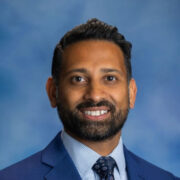
 Chad Ellimoottil, MD, MS
Back to Meet the Care Team
Urology
Urology Treatment Team
The Department of Urology is home to a multidisciplinary group of physicians and scientists who share a common purpose: understanding, treating — and curing — a wide array of urologic diseases and conditions. In addition to the Division of Urologic Oncology, the U-M Department of Urology includes Divisions of Andrology, General and Community Urology, Endourology, and Neurourology and Pelvic Reconstructive Surgery. Learn more here.
Urologists play an important role in various stages of prostate cancer, including diagnosis, treatment, and post-treatment management.
Procedures
- Prostate Biopsies: Urologists perform prostate biopsies to diagnose prostate cancer.
- Placement of Fiducial Markers for Radiation: Fiducial markers are small implants used to precisely target radiation therapy to the prostate gland. Urologists may place these markers into the prostate gland before radiation therapy begins.
- Procedures for Benign Prostatic Hyperplasia: Urologists perform procedures for non-cancerous prostate enlargement to help patients experiencing significant obstructive urinary symptoms. This includes procedures such as a TURP (transurethral resection of prostate) or HoLEP (holmium laser enucleation of prostate) that remove tissue from the inside of the prostate.
Post-Treatment Management
- Bladder Symptoms Management: Following prostate cancer treatment, patients may experience urinary symptoms such as incontinence, urgency, or difficulty urinating. Urologists assess and help manage these symptoms.
- Erectile Dysfunction Management: Erectile dysfunction (ED) is a common side effect of prostate cancer treatment, particularly after surgery or radiation therapy. Urologists offer a range of treatment options for ED, working closely with patients to select the most appropriate treatment based on individual needs and preferences.
Faculty
Chad Ellimoottil, MD, MS
 John Wei, MD
 Miriam Hadj-Moussa, MD
 Bahaa Malaeb, MD, FACS, MBA
 Yooni Blair, MD
 Susanne Quallich, PhD, NP
 Andre King, MD
 James Dupree, IV, MD, FACS
 Dana Ohl, MD
 Jessica Phelps, MD
 Neil Pugashetti, MD
 Brian Stork, MD
 Adam Walker, MD
 Paholo Romo, MD, MPH
 Anne Cameron, MD
 Priyanka Gupta, MD
 Giulia Ippolito Lane, MD, MS
Chad Ellimoottil, MD, MS
John Wei, MD
Miriam Hadj-Moussa, MD
Bahaa Malaeb, MD, FACS, MBA
Yooni Blair, MD
Susanne Quallich, PhD, NP
Andre King, MD
James Dupree, IV, MD, FACS
Dana Ohl, MD
Jessica Phelps, MD
Neil Pugashetti, MD
Brian Stork, MD
Adam Walker, MD
Paholo Romo, MD, MPH
Anne Cameron, MD
Priyanka Gupta, MD
Giulia Ippolito Lane, MD, MS